
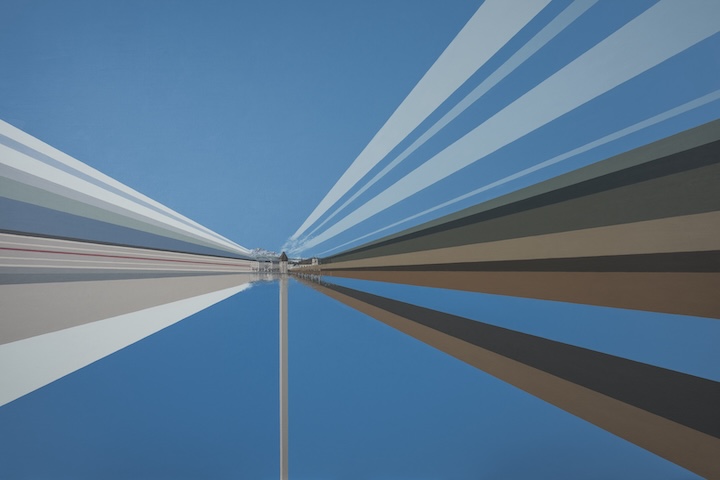
Carolina Fontana, Z·E·N (CH, Nevado Grondelwald), 2026. HST, 100 x 150 cm. Photo © Marcia Battaglia.
– Texte en français – It was in November, in the hush of the off‑season, that Carolina Fontana first encountered Switzerland — a world of white and silence, a purity she recognized from her native Uruguay. She wandered through the cantons of Geneva, Bern, and Lucerne, sketchbook in hand, alert to those rare instants when the gaze tilts and the familiar gives way to revelation. From these wanderings emerged Z·E·N: a series of contemplative paintings that seem, at first, purely abstract, yet disclose — to anyone willing to draw nearer — what the world’s relentless pace keeps hidden from us. Interview.
You’ve worked in Spain, in China, and now in Switzerland. Does your way of looking at a landscape shift depending on where you are, or are you searching for something more universal that cuts across cultures?
What matters to me isn’t whether a place is beautiful or the landscape particularly striking. I’m looking for the moment when something shifts inside me — a click, a change in my mindset. The places I paint are places where something in my way of seeing has been altered. It doesn’t matter whether that happens in China, Spain, Uruguay, or Switzerland. It’s that inner connection that decides, not the scenery.
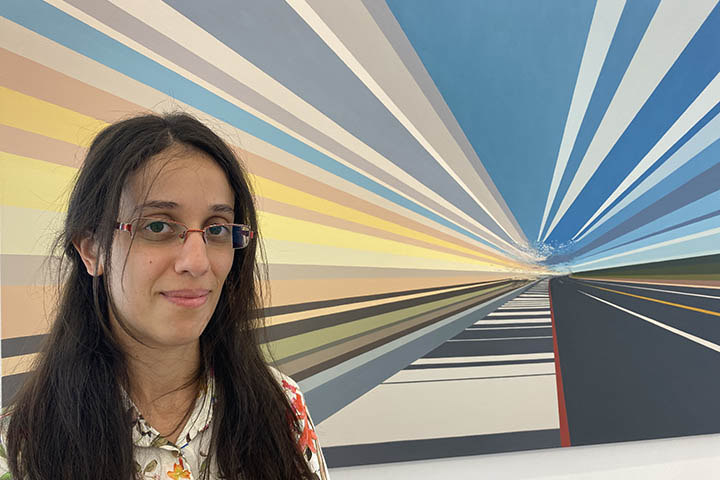
Carolina Fontana. Photo : Jacques Magnol.
How do you recognise that moment?
Sometimes I arrive with an image already formed in my mind, I find the spot, and everything seems perfect. And then I turn around and see something else — something I hadn’t planned on, that touches me more deeply. It’s always an inner feeling that decides. I take my own photographs, I make my own sketches on the spot, in the actual place. I couldn’t work from images taken by someone else. The sketchbook, the eye, the body present in the place — all of that is part of the process.
In this series, did Switzerland — its mountains, its quietness, its very particular sense of neutrality — influence the way you approached the work?
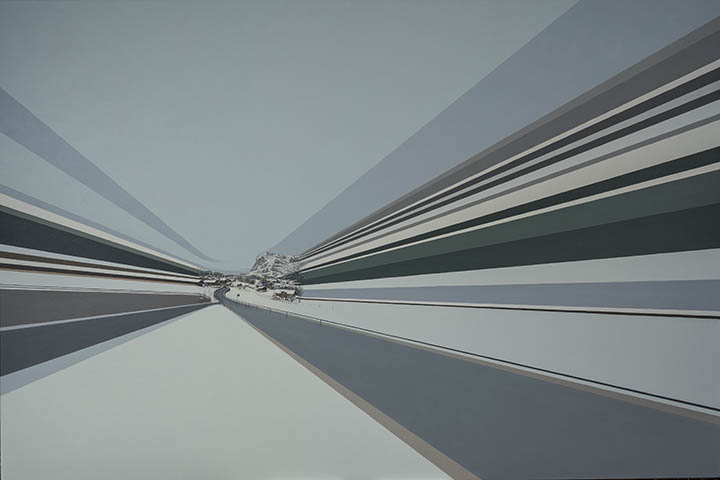
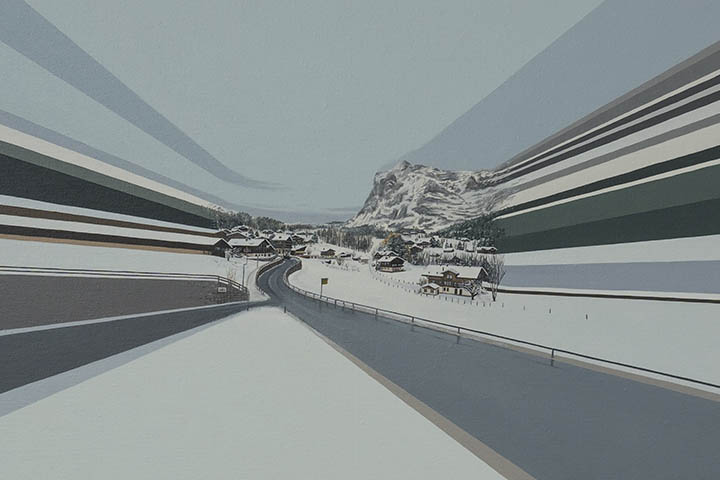
In Uruguay, people say we are the Switzerland of the Americas. There is something shared in that quietness, in that way of inhabiting the world. I found in Switzerland the same peacefulness I know at home — which is why in the exhibition you find a painting from Grindelwald hanging alongside one from Punta del Este: they carry the same feeling of calm.
I came to Switzerland for the first time in November, off-season. Everything was quiet, white, strikingly pure. Geneva welcomed me — it’s the city that started everything for this project, and it holds a special place for me. From there I travelled through the Interlaken area, Grindelwald, Lauterbrunnen. I fell in love with Lucerne — that covered bridge, the old paintings on the wooden panels, the way art, history, and landscape come together. For an artist, that’s a rare combination. I ended my tour in Zurich, so different from the rest, but fascinating in its own way. And now that it’s nearly summer, I want to see all of it again in a different light — I’m going back to Montreux and Interlaken after Geneva.
Your paintings carry a real sense of calm, almost a breath. Yet you also work on hyperconnectivity, algorithms, and AI. How do these two worlds coexist in your daily practice?
It all started in Shanghai. I was living there and communicating with my friends and family through screens — photos, live transmissions on Instagram, video calls. One day I was standing at the top of the Pearl Tower, one of the experiences that would later become a painting. I ended the call and thought: what reality did I actually show them? Just a frame on a small screen. That moment triggered everything. We believe we’re living in the world, but we’re moving through it filtered by a device that reduces, frames, and accelerates everything — and we mistake that frame for reality itself.
Oil painting — this very traditional, very manual medium — is for me a form of resistance to that. What I’m trying to put into image is the effect of this speed: if you live your life at that pace, everything becomes abstract, you never get close enough to truly know anything. That applies to landscapes and to people alike. You pass someone in the street and they’re an abstract figure to you. But if you stop, if you take the time to talk to them — that’s when life starts to make sense.
Does your painting try to resist the way digital images construct our perception, or to offer a different way of engaging with it?
What I want is for people to slow down. Seen from a distance, my paintings can look like pure abstraction — colour, form. But to understand what is really happening, you have to get closer, stop, and look. That physical movement is already an act in itself. My work doesn’t end with the painting as an object: it includes what the painting makes people do. When someone performs that gesture of approach, for me the work is complete. It’s an invitation to a different attitude toward life. And the painting doesn’t need to tell you this — it draws you in on its own.
You talk about an art that goes beyond the object itself. How do you recognise the moment when the work starts to exist outside its physical form?
Everything starts with an idea of what I want to transmit. I work in oil, but also in installation and other languages. In each case, there’s something inside that wants to find a way out — something for which written or spoken words aren’t quite enough. They say one image speaks more than a thousand words. But it’s not even the image alone: for me, the artwork is the movement people make when they encounter one of my paintings. That gesture of drawing closer — stepping forward, leaning in — is a kind of performance in space. When it happens, the painting is finished.
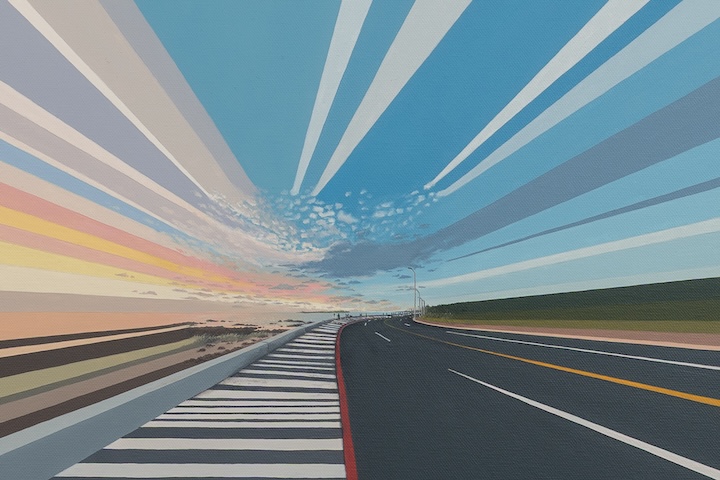
Carolina Fontana, Z·E·N (PDE Atardecer Rambla Este), 2024. HST, 100 x 150 cm. Photo © Marcia Battaglia
« This painting (above) is inspired by Punta del Este, the city where I live in Uruguay — a quiet place where ideas settle naturally, and where every sunset becomes an event. The particular quality of the coastal air gives the sky shades of pink, orange, yellow, and red of almost unreal intensity. The lines of the composition draw you straight into it.
I wanted to bring this painting to Switzerland to share a piece of my daily life — and perhaps remind people of something essential. We spend our days in front of screens, gradually losing our sense of real colour and the natural rhythm of light. These sunsets reconnect us to nature and to ourselves. Scientists speak of the circadian cycle: when we stop perceiving the shifts of light throughout the day, we lose our sleep, our balance. It’s something so many young people experience today without understanding why.
For me, a sunset is a daily gift — free, spectacular, and extraordinary. One that city life has taught us to stop seeing. » Carolina Fontana.
Your series is titled Z·E·N. Is that a statement, an aspiration, or a slightly playful way of commenting on the world we live in?
Zen, in Buddhist philosophy, invites you to observe your own thinking — to calm down, to see things clearly. That’s also what I try to put into the colours and the palette of these paintings. But notice that the title isn’t written Z-E-N: there are dots between the letters, raised midpoints. That’s deliberate. I couldn’t claim the arrogance of saying my paintings are Zen — that’s a level of elevation I would never presume to have reached. I’m not God, I’m not the Buddhist Zen. The dots create distance, humility. And they also correspond to something visual in the triptychs: the gaps between the panels. Everything seems connected, but there is always a small space in between. Those are the dots of Zen — perfection approached, never seized.
And the title of the Geneva exhibition — Parallax — how did that come about?
It was the curator Manuel Neves who proposed it, and I felt it was exactly right. Parallax, in geometry, describes the apparent shift in position of an object depending on the point of observation — it’s used notably to measure the distance between stars. Think of the Bernina Express: you look out the window, the nearby trees rush past, while the mountains in the background seem almost still. Everything depends on the relationship between the observer and what they’re looking at. That’s precisely what these paintings do: they change according to where you stand, according to the distance. The title brings the viewer into the work. It’s not only about the painting — it’s about the painting and the people moving around it.
Carolina Fontana – Interview, Jacques Magnol. May 20, 2026.
Carolina Fontana is a Uruguayan artist born in Montevideo and based in Punta del Este. Her series Z·E·N is currently on view at Galerie Xippas, Geneva, as part of the exhibition Parallax.
Carolina Fontana – Parallaxe
22 mai – 27 juin 2026
Xippas Genève
Rue des Sablons 6
1205 Genève


