
What Happens to Images When We Stop Telling Them What to Mean
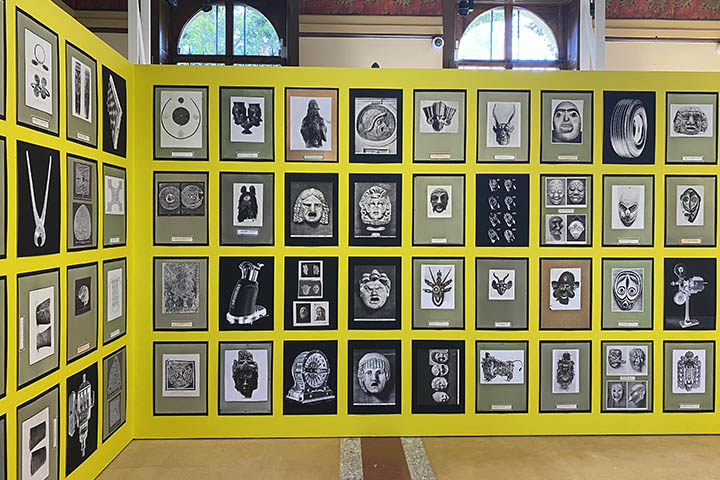
The Eranos Archives, Laboratory of the Anarchetype. Partial view of the exhibition. Photos : Jacques Magnol.
Thousands of images dormant for sixty years in grey boxes. A Cypriot figurine that seems to gaze, across time, at a 1940s camera. Tibetan mandalas side by side with European alchemists’ diagrams. And somewhere in the midst of it all, a question that concerns us all: what do human cultures truly share — and what violence do we do them by claiming to know?
This is an exhibition on view until 9 May at the Centre de la photographie Genève — and behind it, a story worth telling. To understand how it came about, we need to go back to London, in 2014, to the dusty corridors of the Warburg Institute.
The anarchetype, or how seven years of tenacity resurrected forgotten archives
There is something almost magical about the way great discoveries happen. Not through calculation, not through method, but by chance — that chance which Zoe A. Keller modestly calls « pure exploration. » In 2014, this young Genevan researcher was completing an internship at the Warburg Institute in London, that discreet temple of art history tucked away in Bloomsbury. Her mission? To contribute to the colossal digitisation of a collection of 350,000 photographs, assigning each image a date, a provenance, a context. Painstaking, repetitive work — and yet decisive.
For it was while wandering between the shelves, searching for clues to date a Mesopotamian artefact or identify an archaeological motif, that Keller stumbled upon a series of large grey archive boxes, lined up on a dusty shelf. About a hundred identical boxes, bearing strange and evocative titles: Tree of Life, Serpent Symbolism, Ouroboros, The Great Mother, Dragon and Whale. She opened them. Inside: thousands of black-and-white images — reproductions of Mesopotamian sculptures, medieval manuscripts, Tibetan mandalas, Navajo sand paintings, alchemical diagrams. More than three thousand photographs stapled onto green or brown cardboard, lying there for decades, separated from the rest of the collection, as if forgotten.
These were the Eranos Archives.
A buried world, a persistent obsession
Who was behind this collection? A woman — Olga Fröbe-Kapteyn — who between 1930 and 1950, from her home in Ticino, had assembled these thousands of images under the intellectual influence of Carl Gustav Jung. The idea: to build a visual library of archetypes, those great universal figures that Jung believed were inscribed in the collective unconscious of all humanity — the hero, the mother, the labyrinth, the cross, the serpent. The images are not classified by period or region of origin, but by archetypal theme. A Cretan figurine and a Balinese mask might thus sit side by side in the same box, united by their shared belonging to the category « Great Mother. » A logic that says everything about a project that is at once fascinating and deeply ambiguous.
Keller is transfixed. But her internship leaves her no time to linger. She closes the boxes, returns to Switzerland, and carries these images with her into a corner of her memory. « It stayed with me, » she says simply. For five years, the Eranos Archives continue to haunt her.
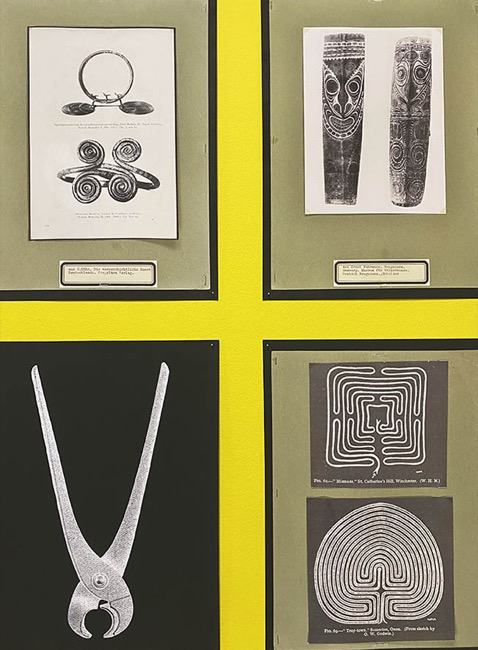
The Eranos Archives, Laboratory of the Anarchetype. Detail of the installation.
The encounter that changes everything
In 2019, at HEAD — Genève, where she works as a teaching assistant, Keller attends a presentation by a guest artist: Batia Suter, a Dutch artist whose practice is built entirely around found images. Suter collects, assembles, and rearranges hundreds of photographs according to formal and intuitive logics, creating visual collisions that bring unexpected meanings to the surface. « When I saw her work, I thought: this is the person with whom I could approach this collection. »
The proposal is made, accepted. What follows is a long and winding adventure, punctuated by trips back and forth to London, brutally interrupted by the pandemic — Keller confined to Geneva, Suter stranded in Amsterdam, the archives inaccessible in London — then resumed, stubbornly, as soon as circumstances allowed. Keller begins by reproducing some eight hundred images on her own, which she shares with Suter. The two women then choose together, seated before open boxes, without any predetermined framework. « Yes, no, yes, no. It’s very intuitive. »
The final selection would take into account the exhibition space — the Centre de la photographie Genève, whose director Danaé Panchaud had agreed to host the project — and the visual recurrences that Suter identifies between images, her signature approach. To this was added an idea from Suter herself: to dive into her own personal archives and extract images of manufactured objects from the same era as the Eranos collection — cameras, machines, industrial objects. To place in tension two worlds that were contemporaneous yet radically opposed: on one side, the triumphant industrialisation of the postwar period; on the other, those intellectual circles in Ticino who had turned their backs on it, dreaming of a return to the land, of vegetarianism, of spirituality. The same era, two speeds, two visions of the world.
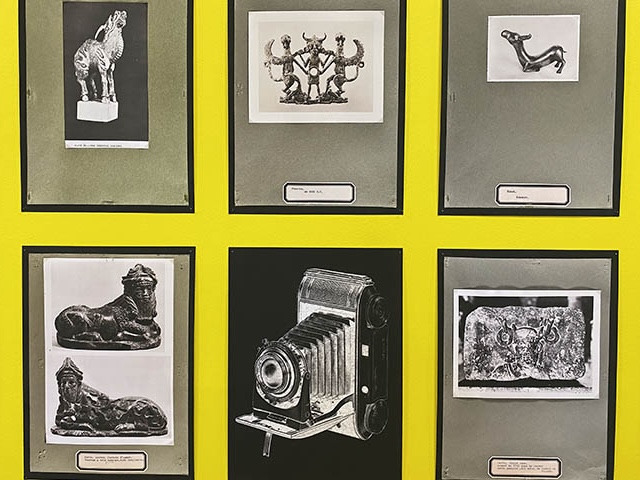
The Eranos Archives, Laboratory of the Anarchetype. Detail of the installation.
When the archive resists its own categories
But the project goes far beyond a beautiful exhibition of rare images. What drives Keller at a deeper level is a theoretical question as simple as it is explosive: can we look at these archives today without reproducing their blind spots? For the Eranos Archives are inseparable from Jung — and Jung is a problematic figure. His antisemitism, his political ambiguities during the war, his universalism that flattens cultural differences in the name of finding what unites humanity: all of this permeates the collection, conditions its logic.
It is the reading of Frantz Fanon that opens a way out for Keller. This Martinican psychiatrist, committed to the Algerian independence struggle, had critiqued Jung with surgical precision: the collective unconscious is not innate — it is acquired. It is cultural, historical, shaped by the stories we are told, the images we are shown, the power structures within which we grow up. Archetypes are not universal: they are the product of situated conditions, often of imposed dominations.
From this fracture, Keller forges her own concept: the anarchetype. A neologism built on the tension between archetype and anarchy — not in the sense of chaos, but in the sense given to it by thinkers such as David Graeber: horizontal forms of organisation, founded on consent, dialogue, and permanent negotiation. Where the Jungian archetype seeks to unify, to close, to hierarchise, the anarchetype embraces contingency, difference, and productive instability. The question is no longer what all these images have in common — but what their frictions, their contradictions, their irreducible singularities can teach us.
Seven years for an exhibition
The result of all this work has been on view since 19 February at the Centre de la photographie Genève, in an exhibition entitled Uqbaroxy. The Eranos Archives, Laboratory of the Anarchetype. Seven years have passed since Keller first put the idea to Batia Suter. Seven years of research, travel, lockdown, institutional negotiations, theoretical reflection, and repeated rounds of selection and reselection.
What the exhibition offers is an archive brought back to life — but not restored to its original state. The Eranos images are redistributed here according to a different logic: no longer that of Jungian universalism, but that of relation, of dialogue between differences, of tension rather than synthesis. Batia Suter deploys her practice of assemblage; Keller brings her intellectual rigour and her theoretical essay. Two practices that do not dissolve into one another, but touch — and it is precisely in that in-between space that something new becomes visible.
An exhibition born from a fortunate accident in a London corridor, and carried for seven years with quiet determination. Exactly the kind of project that archives need to stop sleeping.
Uqbaroxy. The Eranos Archives, Laboratory of the Anarchetype
Zoe A. Keller et Batia Suter
Centre de la photographie Genève
Prom. des Bastions 8
1205 Genève
jusqu’au 9 mai 2026


