
Viola Poli, Materials in Transformation
At Duplex, Viola Poli’s work unfolds like a living organism in transformation. Nothing is fixed here: neither materials, nor forms, nor even the status of the artworks themselves. The artist develops a plastic language rooted in self-made substances—bioplastics derived from ashes, plants, and natural pigments, as well as fabrics infused with beeswax—which she cooks, transforms, and allows to evolve over time. These fragile, translucent surfaces immediately evoke skin: a sensitive membrane, a porous boundary between interior and exterior.
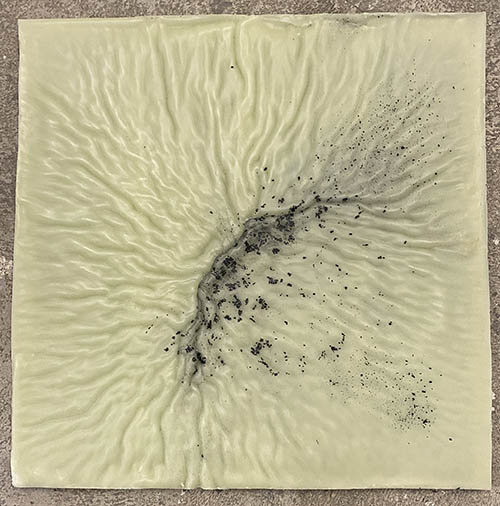
Viola Poli, Die Haut des Raums (rimasugli), recycled wax, charcoal. 2026.
This analogy is central. In Poli’s practice, the human body and the planet mirror one another. Skin, like the earth’s surface, is a site of inscription: it retains visible traces of invisible processes, of buried histories, of slow transformations. The exhibition thus becomes a space for observing these subtle phenomena, where each material acts as a repository of memory. The wall pieces, as well as the elements on the floor—wax tiles, fragments, residues—are remnants of past installations, reactivated within a new context. Poli does not produce closed objects, but cycles. She questions what remains of an artwork after its disappearance, how a form persists, migrates, and recomposes itself.
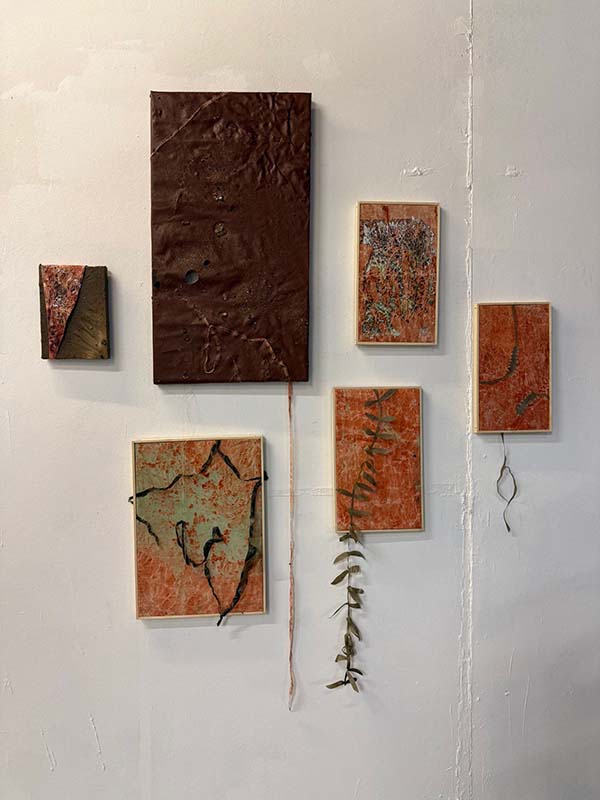
Pneuma (rimasugli) Bioplastic with ash, fabric with beeswax and natural pigments, 2025–2026 (burgundy painting). Strato di sottopelle (rimasugli) Bioplastic with ash, fabric with beeswax and natural pigments, 2024–2026 (orange and grey paintings). Photo : Viola Poli.
At Duplex, this logic takes on an almost archaeological dimension: the artist frames remnants, exhibits fragments, and composes with what endures. The installation becomes a milieu, an ecosystem in which elements interact, respond to one another, and continue to mutate. The space itself seems affected, as though it absorbs these living materials.
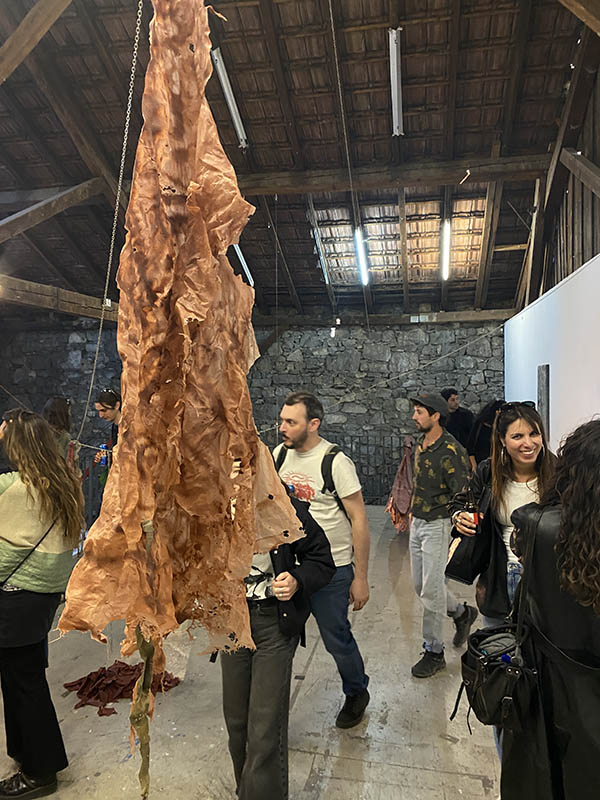
Exhibition view – installation for the performance lo spazio si spella by Jasmin Sisti and Viola Poli. Photo : J.M.
It is within this context that the performance created with dancer Jasmin Sisti takes place, the result of a collaboration initiated a year ago. Initially invited to design a scenography for Sisti’s choreographic work, Poli here engages in a true dialogue, where body and matter become inseparable. The performance, conceived in situ, extends the concerns of the exhibition: transformation, adaptation, and the porosity between forms.
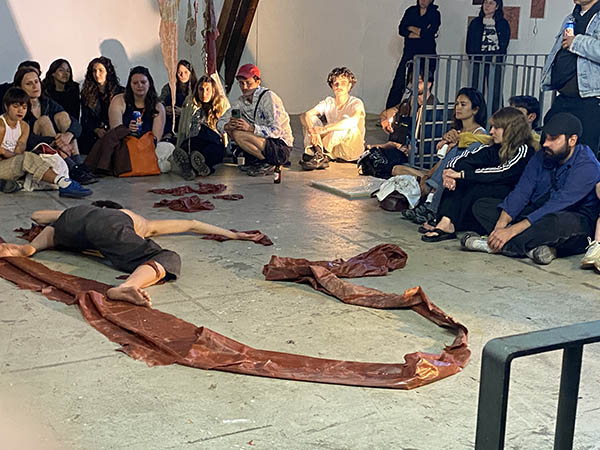
Lo spazio si spella, Jasmin Sisti & Viola Poli, performance, April 24, 2026. Photo : J.M.
In Lo spazio si spella, the dancer’s body explores an environment in flux. The movements are minimal, almost imperceptible, yet they reveal deep dynamics, internal forces at work. Like Poli’s materials, the movement is slow, organic, in constant evolution. The body does not simply move through space: it immerses itself in it, inscribes itself within it, transforms with it. Materials, sound, and physical presence compose a sensory landscape in which boundaries dissolve.
Thus, the exhibition and the performance become one: together they activate a reflection on the cycles of the living, on the capacity of forms to endure, to transform, and to continue acting far beyond their initial appearance.
Jacques Magnol
Evoluzioni de Viola Poli
Lo spazio si spella, performance de Jasmin Sisti et Viola Poli
Duplex
9 rue des Amis
Genève


