
Mitja Tušek: The Faces of the World as a Pictorial Ecosystem
Two groups of recent paintings make up Mitja Tušek‘s exhibition — a Slovenian artist who became a Swiss citizen, trained in Geneva and based in Brussels since the early 1990s. Together, they continue an inquiry pursued since the 1980s around three inseparable threads: the materiality of paint, the instability of the image, and the fragility of what we call identity.
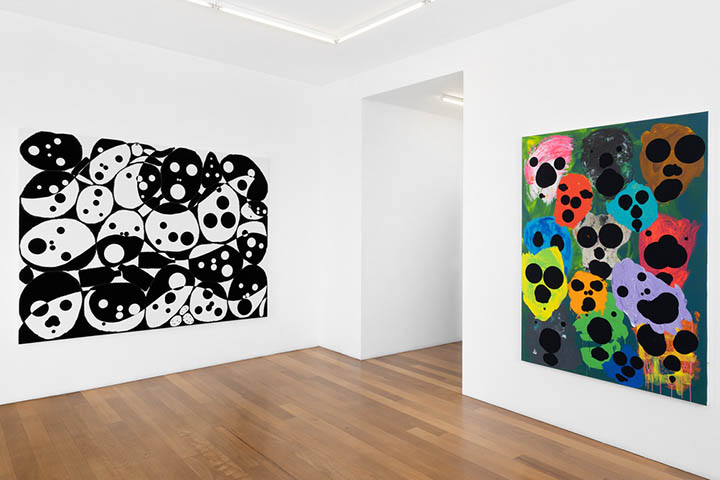
Mitja Tušek, « Avec omega, pomme, haricot, cornichon, rien, bouteille ». Galerie Xippas. Photo Julien Gremaud.
The first group arrests you with its density and strangeness. Faces emerge from a worked surface of smears, knife strokes and poured pigment, in which figures appear and then waver, as though caught in a substance that reveals them as much as it swallows them whole. Each portrait is built from nine black circles, deeply matte, of varying sizes and often overlapping. The number is not arbitrary: it echoes the nine spheres of Dante’s Divine Comedy, where paradise and hell each organise their populations of saints and sinners. In Tušek‘s hands, every face seems to carry its own intimate and indecipherable blend of vice and virtue.
These figures coexist on the canvas without hierarchy or border. To make sense of this cohabitation, one might reach for the concept of biocoenosis, formulated in the nineteenth century by the biologist Karl Möbius: not a single species observed in isolation, but the full community of organisms sharing a common space and continuously shaping one another. Tusek’s faces form something of that order — a pictorial ecosystem, alive and unstable. One also thinks, inevitably, of the mosaic of avatars and the gridded faces of virtual meetings: those assemblages that have become the ordinary landscape of our time, familiar and yet strangely abstract.
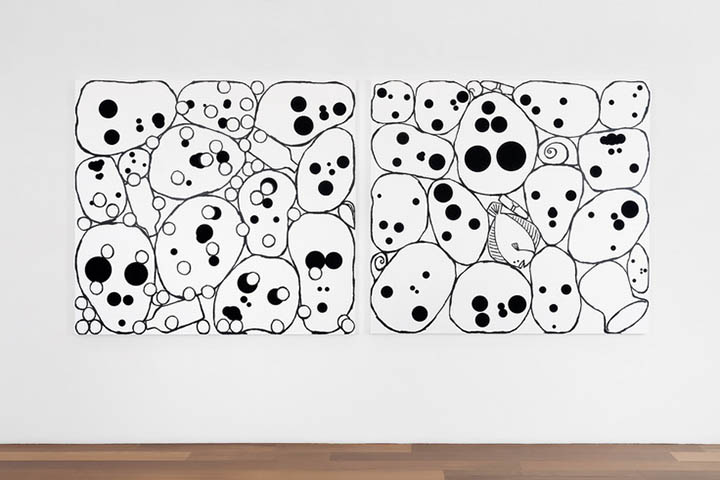
Mitja Tušek, « Avec omega, pomme, haricot, cornichon, rien, bouteille ». Galerie Xippas. Photo Julien Gremaud.
The second group shifts the mood entirely. Colour gives way to black and white, the register turns more graphic, almost caricatural. Where faces once overlapped to the point of dissolution, the composition now opens into a looser network, figures articulated in relation to one another, trapping in their interstices objects of puzzling presence — bottles, cigars, fruit, a hammer, a cat. The painting makes no attempt to reassure or resolve: it stirs the signs, disrupts hierarchies, and keeps wide open the question of what it means to represent anything at all.
Across both series, Tusek confirms the coherence of a practice nourished as much by literature as by biology, yet never weighing on the viewer. The canvas remains what it has always been for him: a space of precarious coexistence, where faces — like the images that saturate our daily lives — hold their balance between singularity and dissolution.
Jacques Magnol
Mitja Tušek, « Avec omega, pomme, haricot, cornichon, rien, bouteille »
Galerie Xippas
Rue des Sablons 6
1205 Genève


