
Living with Minimalism: A Lesson in Interiors
There is something almost paradoxical about the idea of living with minimal art. These works — reputedly cold, cerebral, deliberately impersonal — steel plates laid directly on the floor, fluorescent tubes fixed in a corner, metal cubes aligned with factory precision — seem at first glance better suited to the antiseptic white cube of a gallery than to a living room where life accumulates. And yet. Hank S. McNeil Jr. spent decades proving otherwise, in his Philadelphia townhouse.
In the McNeil home, Dan Flavin’s radiant light enfolded the living space and engaged the reflective surface of its neighbor work, Carl Andre’s Steel-Zinc Alloy Square. Behind, works Donald Judd and Carl Andre. All works offered in Defined Space: The Collection of Henry S. McNeil, Jr. on 20 May 2026 at Christie’s in New York
A discreet but visionary collector, McNeil brought together some of the most important artists of the American postwar period — Carl Andre, Donald Judd, Dan Flavin, Sol LeWitt, Richard Tuttle, Fred Sandback — and installed them not in a house-museum designed to impress visitors, but in a genuinely lived-in space, crossed by the everyday, the changing light of the seasons, and the comings and goings of his children, Calder and Cole, who grew up among these works. For them, these objects were not austere monuments: they were companions in space, familiar presences that quietly shaped the rooms they inhabited.
The Material, Simply Itself
In the light-filled dining room of the McNeil home, Carl Andre’s 66 Copper-Carbon Corner enters into dialogue with a George Nakashima table. The pairing is not incidental. In both cases — the copper plate laid on the floor, the wooden surface with its visible grain — the material is honoured rather than concealed. Nothing pretends to be anything other than what it is. Wood remains wood, metal remains metal.

Le 66 Copper-Carbon Corner de Carl Andre dans la salle à manger familiale baignée de lumière. Également visibles : une table de George Nakashima, une chaise de Sam Maloof et un centre de table de Minas Spiridis.
This is one of the founding principles of minimal art: absolute clarity of materials. Donald Judd insisted that materials — cold-rolled steel, plexiglass, brass — are above all specific materials, and that their direct use, without artifice, confers upon them an irreducible objectivity. Carl Andre defined his practice through the language of elemental matter, seeking to reveal its raw presence rather than press it into the service of representation. In a domestic interior, this logic takes on an unexpected dimension: these works do not decorate the space, they inhabit it with the same matter-of-fact ease as the furniture surrounding them.
Light, Shadow, Atmosphere
In the McNeil living room, a Dan Flavin installation enveloped the space in coloured light, subtly altering the perception of the entire room and entering into dialogue with the reflective surface of a neighbouring Carl Andre Steel-Zinc Alloy Square. This is one of the revelations of these apartment-collections: light is not lighting — it is a material in its own right. Flavin himself spoke of the halo effect that resists any attempt to define its limits: light spreads, its edges recede, and it is precisely there that the poetry of the work resides.

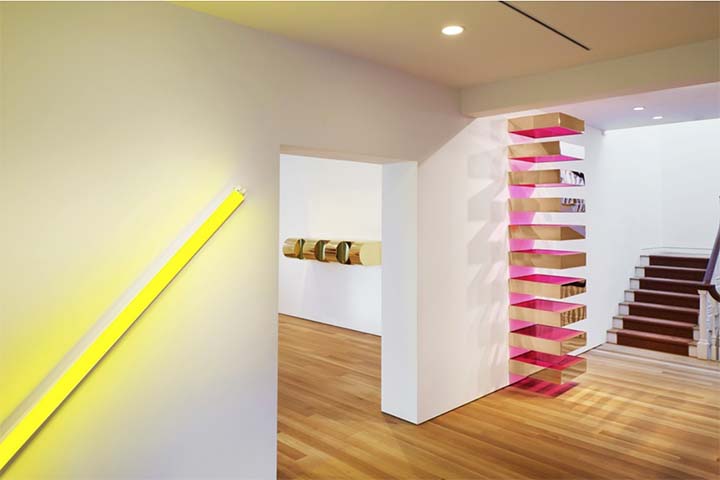
From left to right: Dan Flavin’s the diagonal of May 25, 1963 (to Constantin Brancusi), 1963, and Donald Judd’s Untitled works from 1972 and 1969. All works offered in Defined Space: The Collection of Henry S. McNeil, Jr. on 20 May 2026 at Christie’s in New York
Other artists in the collection work with light more indirectly, through the shadows a work casts or reveals. Richard Tuttle reflected on the additional dimension that shadows lend to his pieces — as if something inside the work were generating another, parallel to it, shifting with the hour and the season. In a house crossed by natural light, these effects are never the same two days running.

On the top floor, fluorescent light from Flavin’s ascending “monument” for V. Taitlin, 1964, blends with natural light from a skylight. The seating area features Ron Arad chairs and artwork by Donald Judd, Carl Andre and Richard Tuttle. All works offered in Defined Space: The Collection of Henry S. McNeil, Jr. on 20 May 2026, and Design in June at Christie’s in New York. Photo: Max Touhey
At the top of the McNeil home, Flavin’s artificial light merged with daylight from a skylight above. In the stairwell, vivid green Judds punctuated each floor. These works did not wait to be looked at: they accompanied every movement, every passing, weaving themselves into the rhythms of domestic life with an active discretion.
Works for Pedestrian Space
One of the most persistent ideas about Minimalism is that it is cold, distant, reserved for minds capable of decoding its theoretical intentions. This reputation may stem from the way these works are too often presented in institutions — isolated on white walls, separated from the visitor by the reverential distance of the museum. The McNeil home tells a very different story.
Carl Andre, whose floor sculptures are quite literally walked across, liked to point out that his works retain the memory of everything that has happened to them: footsteps, rust, the slow wear of time. They do not aim at a fixed ideal state, but welcome change as a dimension inherent to their existence. Fred Sandback conceived sculpture as something that should occupy what he called pedestrian space — ordinary, ground-level space, the kind one moves through without thinking, where art and life cohabit without hierarchy. His Untitled, 3 Part Corner Piece from 1968, present in the collection, embodies this ambition with absolute economy of means: a few stretched threads in a corner suffice to define a volume, to transform an unremarkable area of a room into a space inhabited by thought.

The dining room, featuring works by Donald Judd, Sol Lewitt and Richard Tuttle, with furniture by George Nakashima and Sam Maloof, silver objets by Henning Koppel, and vases by Berndt Friberg. All works offered in Defined Space: The Collection of Henry S. McNeil, Jr. on 20 May 2026, and Design in June at Christie’s in New York. Photo: Max Touhey
In the dining room, Richard Tuttle’s New Mexico, New York, D, #5 (1998) was positioned directly across the table from a 1964 Judd whose yellow and blue colour scheme it echoed — a silent dialogue that only the long time of domestic life allows one to discover and appreciate. Such correspondences do not reveal themselves during a gallery visit. They are gradually learned.

The domestic environment in which McNeil installed his collection brought the works into unique conversations: Richard Tuttle’s New Mexico, New York, D, #5, 1998, was positioned directly across the dining table from the similarly yellow and blue 1964 Donald Judd, Untitled (pictured above), mirroring its color scheme. Photo: Max Touhey
A Parisian Precedent, a Genevan Lesson
McNeil’s experience is not without precedent. In Paris, between 1975 and 1991, Ghislain Mollet-Viéville — collector, art agent and court-appointed expert — had made his apartment on the rue Beaubourg a place where minimal and conceptual art was lived with daily. Donald Judd, Carl Andre, Joseph Kosuth, and André Cadere cohabited there with the ordinary objects of a Parisian interior. Mollet-Viéville had adopted two great references of modernity as his guiding principles: the Duchampian gesture, which locates the work not in its fabrication but in the act of designation, and Mies van der Rohe’s Less is more — a formula he had elevated into a principle of life as much as an aesthetic criterion.

This apartment has since been reconstructed in its entirety at the Museum of Modern and Contemporary Art in Geneva. Photo : Jacques Magnol.
This apartment has since been reconstructed in its entirety at the Museum of Modern and Contemporary Art in Geneva, where it occupies a singular place in the institution’s permanent collection. What the visitor senses there — and what the museum context can only imperfectly convey — is the deeply relational nature of these collections: the works spoke to one another, answered one another, forming echoes that only the long time of cohabitation allows one to work and refine. To such a degree that the apartment as a whole may be understood as a work in its own right — not a collection hung on walls, but a living environment, an inhabited form of thought.
Organising Space Without Weighing It Down
What perhaps most profoundly distinguishes Minimalism from other art forms in an interior is its capacity to organise space without ever encumbering it. A Judd in a corner, a line of Flavin on a wall, a Sol LeWitt suspended from the dining room ceiling: each of these elements structures the room, gives it a rhythm, without ever overwhelming it. Judd himself wrote that the space between two objects can be more present than the objects themselves — more definable, more intense, capable of generating a tension that belongs to neither one alone but arises from their relationship.
The McNeil home illustrated this intuition with consistency: the works did not decorate the rooms, they defined them. Where a traditional painting occupies a wall, these objects redistribute the entire space, orient the gaze, create zones of tension and of breath. The children of the house did not grow up in a museum: they grew up in a considered, rhythmic space, in which every element had been chosen for its ability to hold its place without imposing itself.
Art Without the Pedestal
What the McNeil collection makes visible — and what Mollet-Viéville’s Genevan apartment illustrates in its own way — is that Minimalism may be the form of art most naturally attuned to domestic life. Its works require no pedestal, no frame, no dramatic lighting. They do not need to be staged because they are themselves a proposition for spatial organisation. They narrate nothing, represent nothing, make no bid for immediate seduction — and it is precisely for this reason that they reveal something new each time one passes by them, in the morning on the way out, in the evening on returning, or simply while looking elsewhere.
McNeil understood this: collecting minimal art is not about acquiring cold objects to arrange in a cold apartment. It is about choosing a way of being in the world — attentive to materials, to light, to voids, to the silent relationships between things — and allowing it to slowly infuse daily life, until art and life cease to be two distinct experiences.
Jacques Magnol
Pour en savoir plus:
– La collection de Hank S. McNeil Jr. sera dispersée par Christie’s à New York en mai et juin 2026.
– L’Appartement de Ghislain Mollet-Viéville reconstitué au MAMCO.


